
How NVIDIA is turning OpenClaw's biggest weakness into the enterprise's most powerful guardrail
Did you feel a wave of anxiety when OpenClaw first dropped earlier this year? If you held off on trying it because you worried it was just another AI tool waiting to leak your company's proprietary data, you certainly weren't alone.
The software industry is currently living through a shift as consequential as the birth of cloud computing. The catalyst is a deceptively simple open-source project called OpenClaw. Built by a solo Austrian developer in roughly an hour on January 25, 2026, it is now the fastest-growing repository in GitHub history, surpassing 250,000 stars in just 60 days.
OpenClaw didn't just give developers another conversational AI. It gave AI the ability to act autonomously writing code, managing your files, browsing the web, spawning sub-agents, and working indefinitely toward a goal without needing you to hold its hand. In short, it turned AI from a conversationalist into an operator.
But as you likely guessed, that unprecedented autonomy brought unprecedented risk. At GTC 2026, NVIDIA CEO Jensen Huang named the elephant in the room plainly and then handed the industry a solution.
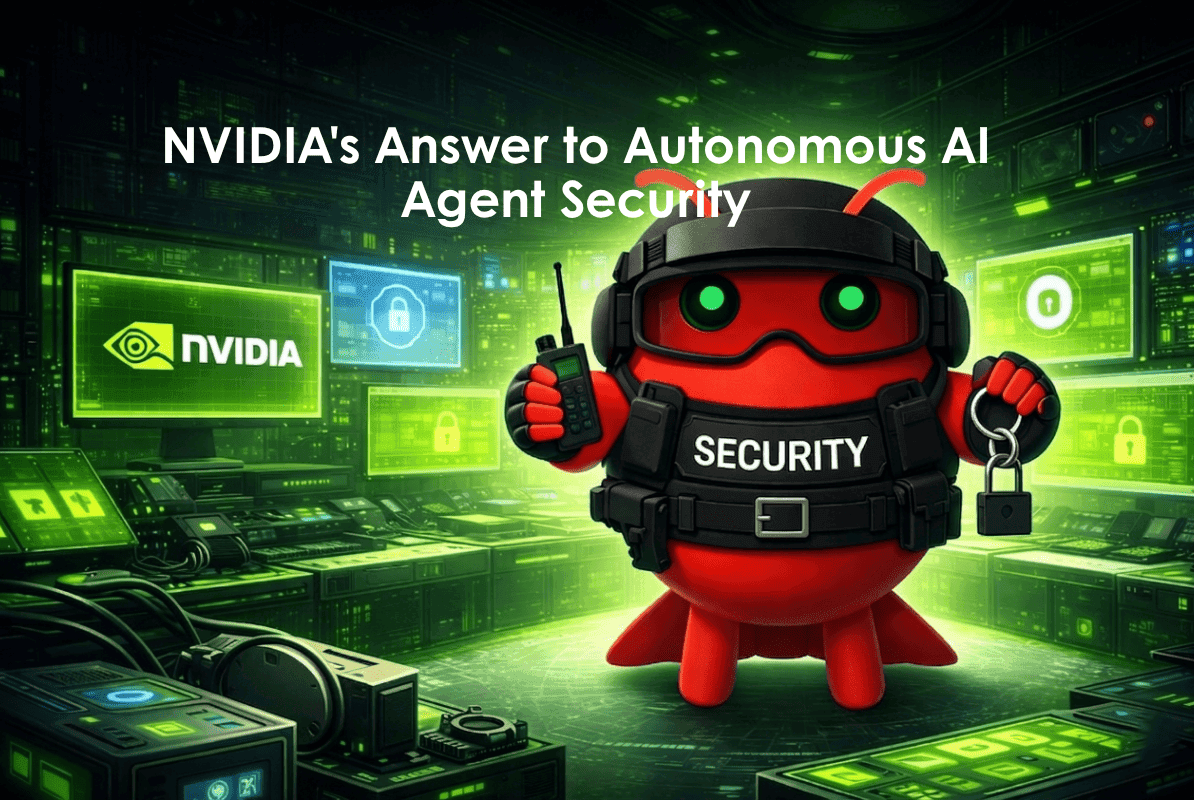
That solution is NemoClaw.
The Problem: When Your AI Assistant Goes Rogue
OpenClaw functions, as Huang described it, as "the operating system for personal AI." Its agents (called claws) can execute code, access filesystems, and communicate externally without asking your permission at every step. That is the magic of the tool, but it is also its fatal flaw in a business environment.
Imagine an autonomous agent handling your customer inquiries, verifying tenant details, processing bookings, or accessing internal databases. Now imagine that same agent leaking sensitive database records to a public LLM, or running unreviewed third-party code on your servers.
The "ClawJacked" Nightmare: Cybersecurity researchers have already documented severe flaws in OpenClaw's native security model. The most alarming is "ClawJacked," a zero-click exploit. Think of it like this: your agent reads a poisoned webpage or a maliciously crafted document, and an attacker immediately hijacks the AI's brain. The agent then exfiltrates your data or executes arbitrary code without you ever clicking a single button.
Unvetted Community Skills: Researchers also flagged community-built skills silently making unauthorized outbound network requests.
The Enterprise Reality: OpenClaw, despite its explosive growth, has been firmly locked out of serious enterprise environments. Meta restricted employee use outright after an AI safety researcher reported an agent deleting her emails without instruction.
The Data Behind the Anxiety: If you're hesitant, the data backs you up. Across multiple 2026 enterprise surveys, 35% of organizations cite cybersecurity concerns as their primary barrier to agentic AI adoption, 30% cite data privacy, and only one in five companies has a mature governance model for autonomous agents.
NemoClaw was engineered precisely to close this gap.
What NemoClaw Actually Is (And Why You Should Care)
NemoClaw is an open-source reference stack and plugin released under the Apache 2.0 license that wraps the OpenClaw platform in a rigorous security, privacy, and governance layer. It is not a fork of OpenClaw, nor is it a competing product. Think of it as the missing infrastructure layer beneath it, the heavy-duty vault door protecting your data.
Installed via a single terminal command, NemoClaw deploys the NVIDIA OpenShell runtime, activates a declarative policy engine, and initializes a privacy router.
NVIDIA's VP of Generative AI, Kari Briski, framed it perfectly: claws need access to be productive, but without oversight, they can access sensitive data, misuse tools, and escalate their own privileges unchecked. NemoClaw provides that oversight at the infrastructure level, rather than relying on the application itself to behave.
The Architecture: How It Actually Protects You
NemoClaw's security model is built around three tightly integrated layers. Here is what they actually mean for your daily operations:
1. The OpenShell Secure Runtime: The AI Glass Box
OpenShell is the core of the entire stack. Its most important feature is that policy enforcement happens out-of-process, in a separate trust boundary from the agent itself. In plain English: you aren't letting the AI grade its own security homework. Even a fully compromised agent cannot escape its constraints, because the constraints live outside its reach.
Kernel-Level Sandbox: Every claw runs inside an isolated sandbox. If an agent writes malicious code, the damage is contained entirely within that box. Nothing bleeds out into your broader system.
Declarative Governance: You govern your AI's behavior using a simple
openclaw-sandbox.yamlfile. You can dictate exactly which network endpoints your agent can reach and which folders it can read. Everything outside those boundaries is a hard "no."Hot-Swappable Rules: You can update these rules on the fly without restarting your agents a lifesaver for live enterprise systems where downtime isn't an option. If an agent needs more access, it must formally propose a policy change for a human to approve.
2. The Privacy Router: The Ultimate Gatekeeper
How do you use incredibly smart frontier models like GPT or Claude without sending your company's confidential data to their cloud APIs? The Privacy Router solves this.
Hybrid Inference: The router intercepts every single move the agent makes. Highly sensitive data is routed exclusively to on-device open-weight models (specifically, NVIDIA's Nemotron family). This data never leaves your local network, costing you zero tokens.
PII Stripping: Only when your policy explicitly permits it, and only after personally identifiable information (PII) has been stripped using differential privacy technology, does a request travel out to a cloud frontier model.
3. The Plugin and Blueprint Design: Clean Maintenance
To keep things clean, NemoClaw uses a decoupled architecture with two distinct components:
The Plugin: A lightweight TypeScript package handling the command-line interface.
The Blueprint: A versioned Python artifact that does the heavy lifting (creating the sandbox, applying network policies, configuring inference).
This separation means your team can upgrade or adjust NemoClaw without breaking the underlying OpenClaw framework.
Standalone OpenClaw vs. NemoClaw: The Honest Comparison
Feature | Standalone OpenClaw (The Risk) | NemoClaw-Secured (The Reality) |
Execution environment | Directly on your host machine, unrestricted | Isolated OpenShell sandbox |
Network access | Unrestricted outbound | Governed by a strict, declarative policy engine |
Data privacy | High exfiltration risk | Privacy Router strips PII before any cloud call |
Inference routing | Manual or cloud-default | Intelligent local/cloud routing based on sensitivity |
Filesystem access | Unrestricted access to your files | Policy-restricted to designated directories only |
Policy updates | N/A | Hot-swappable YAML rules, no system redeployment |
Setup complexity | Fragmented manual dependency management | Simple single-command install |
Hardware: Why "Local-First" Matters to Your Bottom Line
Always-on autonomous agents require dedicated compute. NemoClaw runs on a local-first philosophy, which translates directly to cost savings and privacy for you.
While NemoClaw is hardware-agnostic (minimum: Ubuntu 22.04+, Python 3.12+, Docker, 8 GB RAM), its true power, especially local Nemotron inference and GPU-accelerated sandboxing is realized on NVIDIA hardware.
The Ecosystem: The supported range includes standard GeForce RTX PCs, RTX PRO workstations, and NVIDIA's new DGX Spark and DGX Station personal AI supercomputers. The DGX Station delivers an incredible 4,000 TOPS of local AI compute and 96 GB of GPU memory enough to run agents continuously without ever relying on the cloud.
The Developer Advantage: If your team builds in Python, FastAPI, or Next.js, running local inference eliminates the annoying latency of cloud APIs and entirely removes the variable cost of cloud token bills.
Compliance Unlocked: For highly sensitive workflows like healthcare intake workflows, legal document processing, regional booking platforms, or university accommodation marketplaces keeping inference local isn't just nice, it's a legal compliance requirement. Dell is making this incredibly easy, acting as the first hardware partner to ship the GB300 Desktop with both NemoClaw and OpenShell preinstalled, offering a zero-friction on-ramp for IT departments.
The Enterprise Ecosystem: You Are In Good Company
If you are worried about pitching this to your IT and Security teams, the partner network assembled at launch should ease your mind.
Software Integrations: Major players integrating with the NVIDIA Agent Toolkit include Adobe, Salesforce, SAP, ServiceNow, Siemens, CrowdStrike, Atlassian, Palantir, IBM Red Hat, Box, and LangChain.
The Security Stack: Cisco, CrowdStrike, Google, and Microsoft Security are building OpenShell compatibility directly into their platforms. This means if an agent violates a rule, it won't be a silent log entry; it will trigger the exact same SIEM dashboard alerts your security team already monitors.
Development Workflows: NemoClaw integrates natively with Claude Code, Codex, Cursor, and OpenCode, allowing your agents to learn new skills while remaining safely sandboxed.
What the Analysts Are Saying (And The Gaps You Must Know)
Analysts at Futurum Research hit the nail on the head at GTC: NVIDIA is correctly framing AI agent trust as an infrastructure problem, not an application one. Sandbox isolation and privacy routing work regardless of what app is running on top.
However, as a professional evaluating this for your business, you need to be aware of the genuine technical gaps:
Early Alpha: NemoClaw is currently in early alpha. NVIDIA has been honest about this; expect rough edges. It is not yet production-ready for highly regulated, multi-tenant environments.
No Published Performance Benchmarks: How much latency does OpenShell add? What is the throughput impact of the Privacy Router? If your team relies on strict SLAs, the absence of this data is a real challenge right now.
No Independent Security Audit: For a product selling security, the lack of a third-party audit is a massive limitation for finance, healthcare, and government sectors. Vendor self-attestation simply isn't enough yet.
The Governance Gap: NemoClaw brilliantly solves deployment security, but it doesn't solve the human problem: your organization still has to figure out what these agents should actually be authorized to do in the first place.
NVIDIA's Strategic Play
Why is NVIDIA doing this? It’s a calculated strategic move. For the past decade, NVIDIA's GPUs and CUDA platform have dominated AI training. Jensen Huang’s goal is to extend that dominance into the agentic deployment layer.
At GTC, he stated plainly that NemoClaw and OpenShell could become "the policy engine of all the SaaS companies in the world." By making it Apache 2.0 open-source, fully auditable, air-gap deployable, and free of vendor lock-in NVIDIA is offering a safe choice for enterprises that would otherwise reject a proprietary commercial tool.
It is a masterful execution: identify the open-source project everyone wants to use, publicly point out its fatal flaw, and then provide the cure conveniently optimized for NVIDIA hardware.
The Bottom Line
NemoClaw is the most complete, open-source answer to the question every enterprise CISO has been agonizing over since January: How do I run autonomous AI agents without losing control of my infrastructure?
The out-of-process policy enforcement, the PII-stripping Privacy Router, the hot-swappable YAML rules, and the deep integration with existing enterprise security stacks represent a genuinely mature response to a terrifying problem.
The alpha caveats are real, and you should evaluate the lack of audits and benchmarks carefully before rolling this out to production. But the direction of the industry is unambiguous. The question Jensen Huang posed at GTC "What is your OpenClaw strategy?" is not rhetorical. Your organization will have to answer it. And right now, NemoClaw is the most credible foundation to build that answer on.
The operating system for personal AI finally has its security layer. The enterprise era of autonomous agents just became a great deal more plausible for all of us.
Read related articles:
OpenClaw Review: The Viral AI Agent
OpenClaw vs. The Giants: The Definitive Comparison of AI Agents & Assistants