
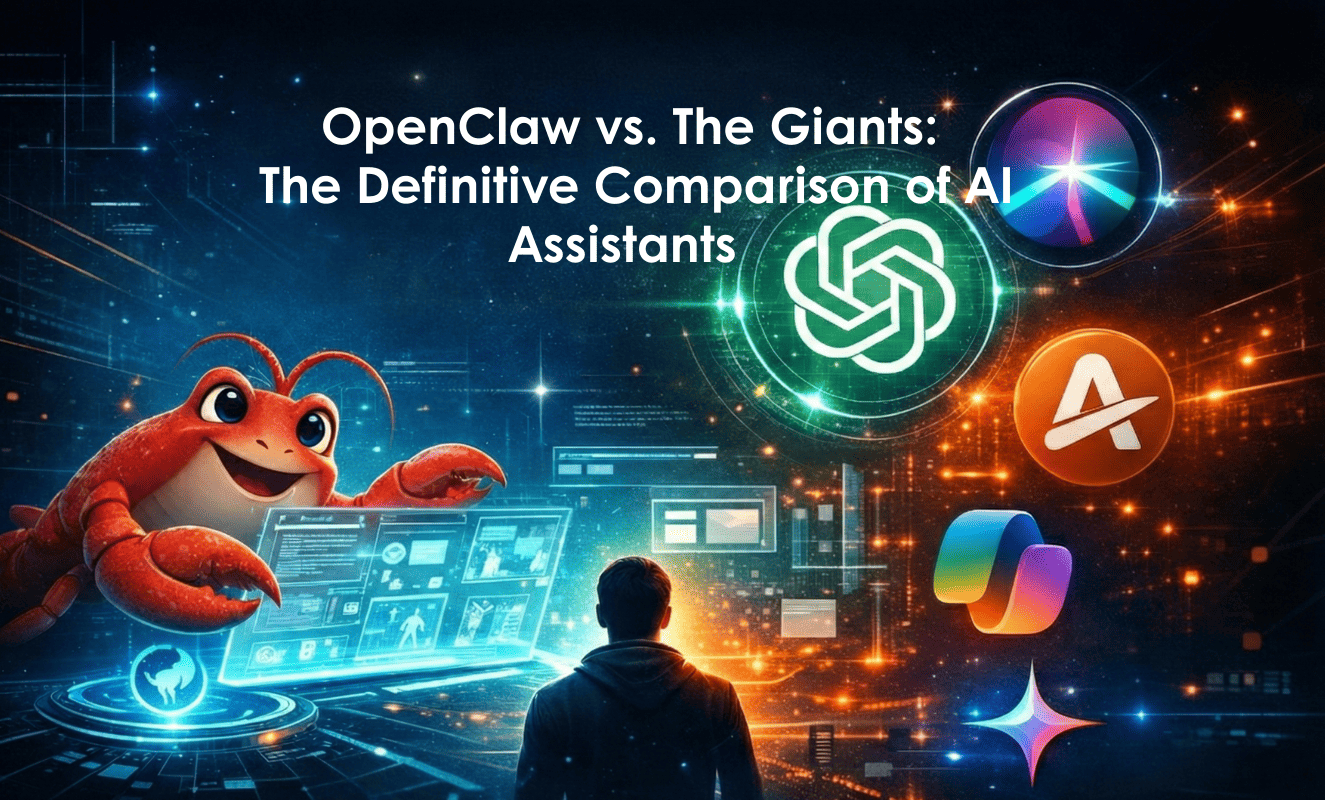
OpenClaw vs. The Giants: The Definitive Comparison of AI Agents & Assistants
In the current landscape of artificial intelligence, a single fundamental difference forces every trade-off discussed in this guide: OpenClaw is a self-hosted agent platform running on your hardware, whereas ChatGPT, Gemini, Claude, and Copilot are vendor-hosted products running in the cloud.
Below is a comprehensive comparison designed to help you understand exactly where each tool fits, using real-world examples and clear distinctions.
1. Core Identity: Agent vs. Assistant
OpenClaw (The "Broker")
What it is: OpenClaw is an open-source, self-hosted personal agent framework. Originally named "Clawdbot" (due to its early reliance on Anthropic’s models), it has evolved into a platform-agnostic tool.
Deployment: You run it on your own machine (laptop, homelab) or a Virtual Private Server (VPS).
Architecture: It is not a single AI model. It is a "broker" or "wrapper" that connects to various AI brains. It is explicitly designed to be local-first with full system access.
Real-Life Use Case: Think of OpenClaw as a digital employee sitting at your desk. You give it access to your files and terminal, and it uses whatever "brain" you hire (GPT-4, Claude, etc.) to do the work.
The Big Tech Assistants (ChatGPT, Claude, Gemini, Copilot, Siri)
What they are: These are managed products or model families hosted by major vendors.
ChatGPT (OpenAI): A conversational product built on the GPT-4/GPT-5 lineage. It offers hosted chat, APIs, and sandboxed code execution.
Claude (Anthropic): A proprietary model family (Opus/Haiku/Sonnet) optimized for safety and reasoning. Includes Claude Code, a specialized tool for terminal/IDE workflows.
Apple Intelligence (Siri): A hybrid system using on-device processing and "Private Cloud Compute" on Apple Silicon. (Note: Apple recently announced a multi-year deal to power later Siri upgrades with Google Gemini).
Microsoft Copilot: An umbrella of assistants integrated into the Microsoft 365 stack (Word, Excel, Teams) and grounded in the Microsoft ecosystem.
Google Gemini: A multimodal model family integrated deeply into Google Workspace (Docs, Gmail) and Android.
2. Architecture & Model Access
The critical distinction here is flexibility vs. integration.
OpenClaw (Model Agnostic): OpenClaw offers "vendor arbitrage." You can configure it via config files to use almost any provider: OpenAI, Anthropic, Z.AI, Venice, or even local models via Ollama. It supports provider failover, meaning if one API is down, it switches to another.
- Real-Life Example: You might use the powerful Claude Opus for complex reasoning tasks, but switch to a cheaper local model for simple summaries.Hosted Assistants:
- ChatGPT/Claude/Gemini: You are locked into that vendor's infrastructure.
- Apple: Uses on-device models for privacy, handing off heavier tasks to its Private Cloud.
Takeaway: OpenClaw is uniquely attractive if you want to combine local + cloud LLMs or avoid vendor lock-in.
3. The "Jarvis" Factor: Autonomy & Proactivity
This is the "killer feature" comparison.
The "Heartbeat" (OpenClaw)
OpenClaw runs as a daemon (a background process) 24/7 with a "heartbeat." It can be proactive.
- Real-Life Example: OpenClaw can text you first. "Good morning. I noticed your home server is down, so I attempted a restart. Also, don't forget your spouse's birthday tomorrow."
Persistent Memory: Unlike ChatGPT's session-based memory, OpenClaw uses local Markdown files as a long-term brain. Users note it "never asks the same thing twice," building a structured knowledge base of your life (e.g., your SSH keys, flight preferences).
The "Session" (ChatGPT, Claude, Siri)
These tools are generally reactive.
ChatGPT/Claude: They function like a "tab in a browser." They wait for your prompt. While they have some memory features, they generally do not initiate contact or run background jobs while you sleep.
Siri: Highly reactive. It responds to voice/text commands with some context but lacks independent operation.
4. "Doing" vs. "Advising": System Control
OpenClaw (Full Access): It has shell access, file system read/write permissions, and browser automation (via Chrome DevTools Protocol).
- Real-Life Example: If you ask OpenClaw to "organize my files," it doesn't just give you instructions. It actually creates folders, moves files, and renames them on your hard drive.ChatGPT/Claude (Sandboxed): They can browse the web or run code in a controlled sandbox, but they cannot reach out and touch your local OS.
- Real-Life Example: ChatGPT can tell you how to write a script to organize files, but you have to run it yourself.Apple Intelligence (App Intents): Siri can take actions within apps (e.g., "add this address to contacts"), but it is limited to what developers allow via App Intents. OpenClaw bypasses this by using generic browser/shell automation to "use" apps like a human would.
5. Ecosystem & Integrations
OpenClaw (The Hub): It connects to a massive array of messaging apps: WhatsApp, Telegram, Slack, Discord, Signal, and iMessage. This allows you to interact with your agent from anywhere.
Microsoft Copilot (The Office Worker): Its superpower is the Microsoft Graph. It sees your emails, calendar, Teams chats, OneDrive files, and CRM/ERP data.
- Use Case: "Draft a reply to this email based on the Excel sheet we discussed in the Teams meeting yesterday." Copilot excels here because it lives inside that data ecosystem.Google Gemini: Similarly deep integration for Google Workspace users (Docs, Gmail, Drive).
6. Privacy, Data Handling & Deployment
OpenClaw ("Private by Control"):
- Philosophy: "Your assistant. Your machine. Your rules."
- Pros: Data and keys stay on your infrastructure. Ideal for privacy if you use local models.
- Cons: You are responsible for security. If you give OpenClaw your SSH keys, you must trust the open-source code and your own security setup.Apple Intelligence ("Private by Design"):
- Philosophy: On-device processing first. For complex tasks, it uses Private Cloud Compute, which ensures user data is never stored on Apple servers.Cloud Assistants (ChatGPT/Gemini/Copilot):
- Philosophy: Managed Trust. Your data lives in their cloud. Enterprise tiers (ChatGPT Enterprise, Microsoft 365) offer contractual data protections and SLAs.
7. Security & Extensibility
OpenClaw (ClawHub): Extensions are called "Skills" (TypeScript plugins).
- The Risk: Because skills can execute shell commands, the open skill market (ClawHub) has been exploited to spread malware.
- The Fix: OpenClaw has recently partnered with VirusTotal to scan skills and reduce malicious uploads. However, the risk remains higher than in managed stores.Vendor Ecosystems: OpenAI’s Plugin Store, Google Workspace Apps, and Microsoft Copilot Agents are heavily vetted and sandboxed. They prioritize safety over raw system access.
8. Developer Experience: Coding
Claude Code: An official Anthropic product designed as a "scalpel" for developers. It lives in your terminal/IDE, understands your git workflows, and manages PRs. It is opinionated and highly integrated.
GitHub Copilot: Tailored for code completion and IDE assistance.
OpenClaw: Not a coding model per se, but a "Manager."
- Real-Life Workflow: You can configure OpenClaw to spawn Claude Code as a subprocess to fix bugs while you are away. It acts as the orchestrator, while Claude Code is the specialist tool.
Summary: When to Use What?
To help you decide, here is a quick guide based on your specific needs.
Use OpenClaw If:
· You need actual execution: You want an AI that can manage files, run scripts, and automate browsers.
· You want "Set and Forget": You need an agent that runs 24/7, monitors your servers or emails, and texts you when something happens.
· You value privacy/control: You want to keep your data on your own hardware or mix-and-match different LLM providers.
· You are technical: You are comfortable using a terminal and managing your own security keys.
Use ChatGPT If:
· You need a reliable generalist: You want the best conversational experience, image generation, and voice chat without any setup.
· You need advice, not execution: You want to brainstorm, draft emails, or analyze data, but you don't need the AI to touch your operating system.
Use Claude / Claude Code If:
· You are a developer: You want a coding partner that lives in your terminal and deeply understands your codebase (Claude Code).
· You need complex reasoning: You prefer Anthropic's "Opus" models for their high-accuracy planning and long-context capabilities.
Use Microsoft Copilot If:
· You live in Office 365: You want an assistant that knows your Outlook calendar, Teams chats, and Excel spreadsheets and can automate workflows inside that specific ecosystem.
Use Apple Intelligence (Siri) If:
· You are in the Apple Ecosystem: You want a hands-free, private assistant that integrates seamlessly with your iPhone and Mac apps.