
PaperBanana: Google's AI Framework That's Changing How Scientists Create Research Visuals
Ask any AI researcher about the worst part of publishing their work, and you'll hear the same grumble: creating diagrams. Hours vanish into tweaking flowcharts, adjusting color schemes, and rebuilding methodology diagrams in Adobe Illustrator or wrestling with Matplotlib code. The irony? Scientists who can train neural networks to recognize tumors still spend entire afternoons making arrows line up properly.
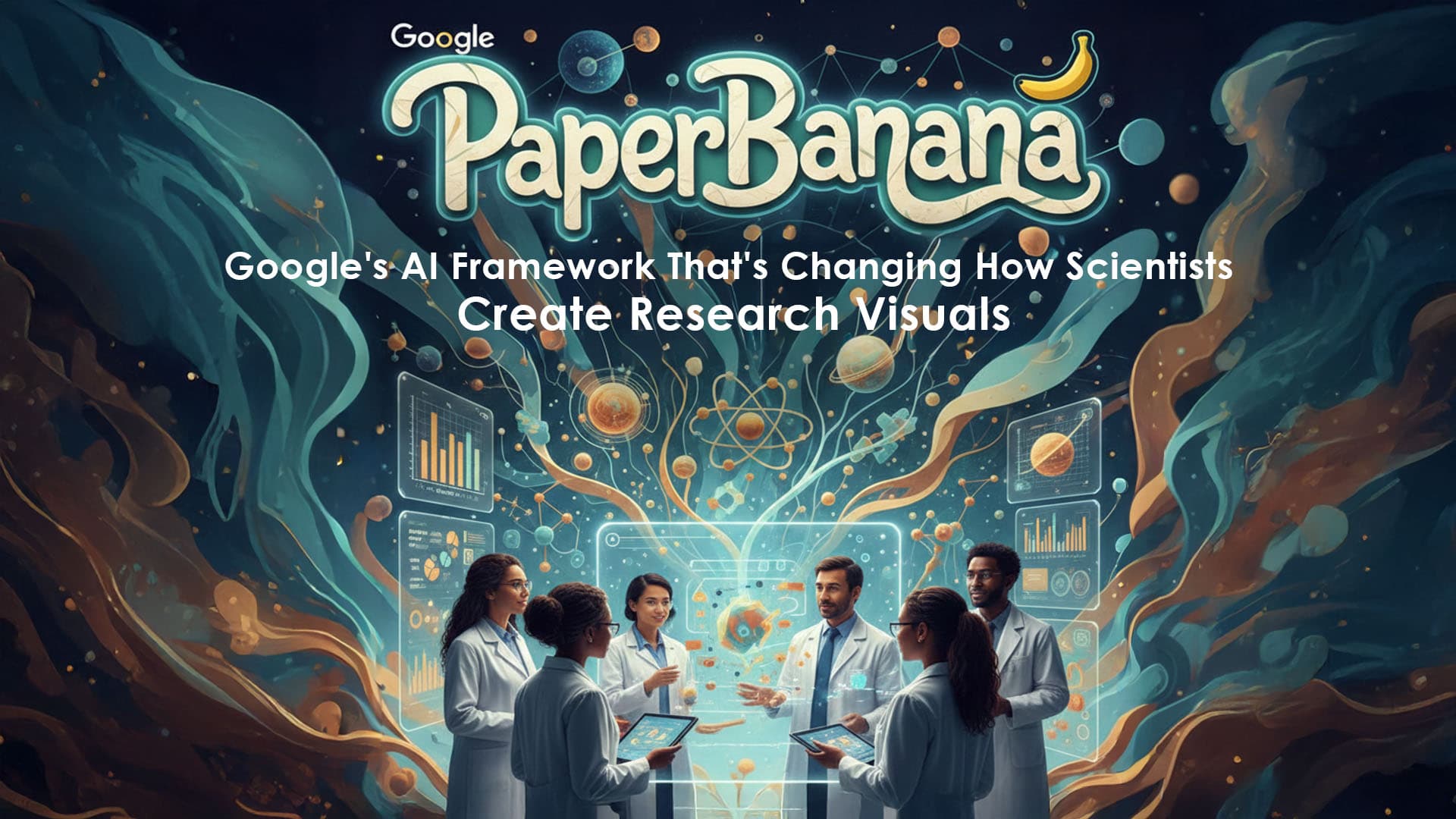
That mundane reality just got a major upgrade. Researchers from Google Cloud AI Research and Peking University released PaperBanana in January 2026—an agentic AI framework that takes rough descriptions and churns out publication-ready illustrations. We're talking diagrams polished enough for Nature or NeurIPS, generated automatically while you grab coffee.
Why Academic Illustrations Are Such a Pain
The illustration bottleneck isn't just annoying; it's a genuine barrier to scientific communication. Methodology diagrams need to be simultaneously accurate, concise, readable, and aesthetically professional. Miss any one of those marks, and peer reviewers will notice. Achieving all four typically demands skills most scientists don't have and time they can't spare.
Graduate students often face the steepest climb. They're already juggling experiments, literature reviews, and teaching duties. Now add learning design principles and mastering visualization tools? PaperBanana offers a lifeline here, democratizing access to high-quality visuals regardless of someone's design chops or career stage.
The framework doesn't just speed things up—it potentially reshapes how researchers allocate their mental energy, keeping focus where it belongs: on breakthrough discoveries rather than Bézier curves.
Five AI Agents Working in Concert
What makes PaperBanana clever is its architectural approach. Instead of asking one AI model to handle everything, the system orchestrates five specialized agents, each tackling a distinct piece of the puzzle. Think of it as an assembly line staffed entirely by AI workers who actually coordinate well.
The Retriever Agent kicks things off by scanning a database for relevant reference examples. This grounds the entire process in real-world academic styling rather than abstract guidelines.
The Planner Agent then translates your method description—often dense technical text spanning thousands of words—into a detailed blueprint for what the visual should contain. It's essentially turning scientific prose into a design brief.
The Stylist Agent acts as your design consultant, extracting aesthetic principles from those reference examples. Color palettes, typography choices, spatial layouts—all the elements that separate "this looks academic" from "this looks like a PowerPoint from 2003."
The Visualizer Agent is where rubber meets road. For methodology diagrams, it uses Nano Banana Pro (powered by Google's Gemini 3 Pro Image model) to render the actual visual. For statistical plots, it takes a smarter route: generating executable Python code using Matplotlib instead of creating images directly. Why? Because image generation models have an unfortunate habit of hallucinating numbers. A bar chart showing "47.3%" might render as "43.7%" if you're not careful. Code generation eliminates that risk entirely.
The Critic Agent serves as quality control, comparing outputs against the original context and providing feedback for refinements. The system runs through this generation-critique loop three times before serving up the final result.
This multi-agent choreography runs on Google's Gemini models handling the planning and critique phases, with Nano Banana Pro managing the visual generation. The whole architecture feels less like prompting an AI and more like managing a small creative team.
Putting It to the Test: PaperBananaBench
Bold claims need hard evidence. The research team built PaperBananaBench—a rigorous evaluation dataset comprising 292 test cases pulled directly from NeurIPS 2025 publications. These aren't simple diagrams; the average source context exceeds 3,000 words of technical methodology descriptions spanning diverse research domains.
The benchmark measures four critical dimensions: faithfulness to source material, conciseness, readability, and aesthetic quality. PaperBanana didn't just edge out baselines—it dominated them. The framework showed a 17% improvement in overall score, with particularly dramatic gains in conciseness (up 37.2%) and readability (up 12.9%). Even aesthetics, the most subjective category, saw a 6.6% boost.
Those numbers translate to diagrams that look professionally crafted. The system excels particularly at "Agent & Reasoning" type diagrams, achieving nearly a 70% overall score. It's also developed an automated aesthetic guideline favoring "Soft Tech Pastels" over harsh primary colors—a subtle detail that makes outputs feel contemporary and polished.
Where It Stumbles
No technology is perfect, and PaperBanana has its failure modes. The most common issues involve what the researchers call "connection errors"—redundant links between diagram elements or mismatched nodes that don't quite align with the described methodology. These typically stem from perception challenges in the underlying vision-language models.
Statistical plots occasionally require human oversight, particularly when dealing with complex multi-panel figures or unconventional chart types. While the code-generation approach prevents numerical hallucinations, it doesn't guarantee that the generated visualization optimally communicates the underlying data patterns.
The framework also assumes you've already written clear methodology text. Garbage in, garbage out applies here. Vague descriptions produce vague diagrams, though the Planner Agent does help by requesting specific details through its interpretation process.
Beyond Research Papers
While PaperBanana was designed for academic publishing, its applications stretch further. The system includes collaborative features hosted on Google Cloud—share a link, and co-authors can comment directly on visuals, streamlining team workflows that previously involved endless email threads with "diagram_v7_final_FINAL.pdf" attachments.
Open-source implementations available on GitHub mean developers can extend the framework to adjacent domains. Educational content creators could use it for tutorial diagrams. Technical writers might adapt it for documentation. Graduate-level instructors could integrate it into research methods courses, teaching students both diagram design principles and how AI tools augment creative work.
The research team already demonstrated PaperBanana's ability to polish existing human-drawn diagrams by applying aesthetic improvements automatically. Sketch something rough on a whiteboard, feed it in, and receive a publication-ready version back. That's particularly valuable for those who think visually but lack execution skills in design software.
The Bigger Picture
PaperBanana represents something beyond a clever automation tool. It's a signal of where AI-assisted research is heading—toward systems that handle the complete workflow, not just isolated tasks like literature review or code debugging.
As vision-language models continue advancing, frameworks like this will likely expand into other scientific fields where complex visuals are essential. Biology researchers drawing cellular pathways, physicists illustrating quantum systems, chemists depicting molecular interactions—all could benefit from similar agentic approaches.
There's also a philosophical dimension worth considering. By automating tedious aspects of academic work, tools like PaperBanana allow scientists to be more scientific. Less time formatting, more time thinking. Less energy on presentation mechanics, more focus on what the presentation communicates.
The "publish or perish" culture in academia creates immense pressure for rapid output. PaperBanana doesn't solve that systemic issue, but it does remove one significant friction point in the publication pipeline. And sometimes, that's exactly what innovation looks like—not revolutionary upheaval, but thoughtful elimination of unnecessary obstacles.
For AI researchers drowning in diagram work, PaperBanana is more than a productivity boost. It's a glimpse of a workflow where the tools finally match the complexity of the thinking they're meant to support.