
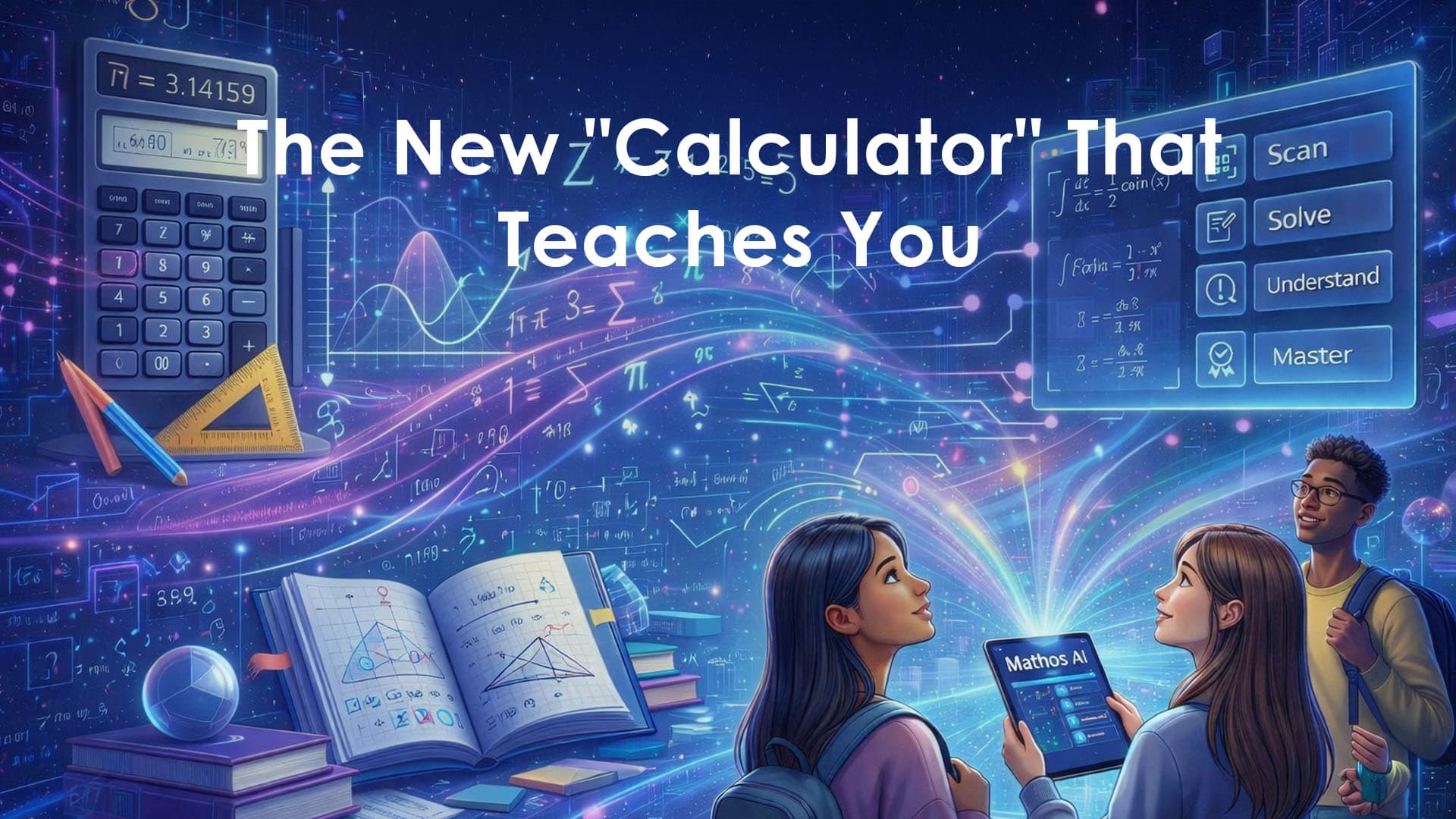
Mathos AI Review: The New "Calculator" That Teaches You
Imagine a calculator that doesn't just spit out an answer but actually teaches you how to get there. That is the promise of Mathos AI (formerly known as MathGPTPro), an AI-driven platform designed to do exactly that.
Unlike simple calculator apps, Mathos focuses on seamless learning and critical thinking, acting as a personalized virtual tutor. It guides students, educators, and lifelong learners through everything from basic arithmetic to advanced calculus and engineering math, emphasizing the "why" behind every step.
The Core Technology: "MathosMax"
The Claim
Mathos AI uses a proprietary model called "MathosMax," which is specifically fine-tuned for mathematics. The company boasts that this model achieves 17% higher accuracy than generalist frontier models like ChatGPT-4o, DeepSeek R1, Mathway, Julius, Photomath, and Symbolab.
The Reality
It is noticeably better at interpreting word problems and complex calculus than base ChatGPT. While it hallucinates less on arithmetic, it is not infallible it is a powerful tool, but not a magic wand.
Workflow & Key Features
Mathos AI differentiates itself with a suite of features designed to mimic a human tutor.
1. Multi-Modal Input Methods
You aren't restricted to typing. The platform supports diverse input styles:
- Text Typing: Standard input.
- Handwritten Images: Snap a photo of your notebook.
- Screenshot/Photo Uploads: Upload images directly from digital sources.
- Voice Prompts: Speak the problem (ideal for accessibility).
2. PDF Homework Helper (ISBN/Textbook Interaction)
This is a killer feature. You can upload full PDF worksheets or textbooks, circle specific questions, and get solutions tied to those exact items effectively turning static textbooks into interactive tools.
3. Comprehensive Subject Coverage
It handles math from K-12 through college levels, covering Algebra, Calculus (limits, derivatives, integrals), Geometry, Statistics, Matrices, and even interdisciplinary subjects like Physics, Chemistry, and Engineering.
4. Personalized AI Tutor
The AI tracks your progress via knowledge graphs and adapts to your style. Instead of just giving the answer, it uses Socratic questioning to guide you to the solution, offers extra hints, and provides alternative solving methods based on your interaction.
5. Advanced Graphing & Visual Tools
It includes an advanced graphing calculator that visualizes functions and plots to help learners see concepts in action.
6. Supplementary Tools
The platform includes video tutorials (with YouTube integrations), practice problem generation, note-taking features, and rewards for engagement to keep users motivated.
Pros & Cons: The Honest Truth
✅ The Strengths
Superior Accuracy: In recent tests, it reportedly outperforms leading models like DeepSeek R1 and Photomath by up to 17%.
Detailed, Human-Like Explanations: It prioritizes teaching the process. Users call it "the best" for step-by-step math explanations.
Flexible Inputs: The support for voice and PDF inputs makes it significantly more accessible than competitors limited to just text or camera.
Interactive Learning: The graphing tools and adaptive feedback mimic a real tutor, keeping learners engaged.
Reliability: It is highly reliable for standard textbook-style questions, particularly in algebra and calculus.
❌ The Weaknesses
The "Free" Version is a Demo: Users report hitting paywalls after just 2 questions. It acts more like a restricted demo than a functional free tier.
Deceptive Pricing: Pricing is often listed in weekly terms ($2.99–$4.99/week). This psychologically masks a massive $12–$20/month cost (approx. $520/year if not managed), which is significantly more expensive than many competitors.
Looping Explanations: A common complaint is that explanations can loop or repeat when a learner is confused, rather than pivoting to a new teaching strategy.
Input Errors: Camera/photo recognition can sometimes misread poorly written inputs.
Visual Gaps: While graphing is strong, some users lament the lack of richer visual diagrams for geometry or proofs.
Edge-Case Struggles: Very advanced or unusual problems (e.g., Olympiad questions or heavily symbolic university math) can still stump the model.
Cheating Risk: There is an "Over-Reliance Risk" where the tool can enable cheating or cause students to skip the actual learning process.
Pricing
Free Plan
You get basic access to the "MathosPro" model. While they don't publish the exact hard cap, users report hitting a wall after a few complex problems or step-by-step requests.
The Feature: You can upload images (take a photo of your homework) and get graphs drawn automatically.Basic ($2.99/week)
$2.99 sounds cheap, but it adds up to $12/month. You get Unlimited access to the standard "MathosPro" model, but you are capped at 100 "MathosMax" queries per week.
100 queries/week = 14 problems/day. If you have a heavy calculus assignment, you will burn this quota in one night.Prime ($4.99/week)
This is $20/month (or ~$260/year if you forget to cancel). This is significantly more expensive than competitors like Photomath Plus ($9.99/mo) or WolframAlpha Pro ($5-7/mo).
The value: Unlimited "MathosMax" (Top-tier accuracy).
Best For: University students in complex Engineering/Math courses who need the "Smartest" model and can't afford to run out of credits during finals week.
Mathos AI vs. The Competition
Mathos AI vs. Photomath
Photomath has a proven track record (2 million+ reviews, 4.7/4.8 ratings) and is more user-friendly with better visual aids for algebra. Crucially, it costs $9.99/month (or ~$69.99/year) much cheaper than Mathos.
The Verdict: Mathos wins on accuracy (+17% claim) and multi-modal inputs (voice, PDF) which Photomath lacks. Use Photomath for affordability and standard algebra. Use Mathos only if accuracy is absolutely critical and you can afford 7x the price.
Mathos AI vs. Mathway
Mathway is a trusted brand with years of operation (vs. Mathos's 4 months) and covers a broad spectrum like trigonometry and vectors. Pricing is $19.99/month (or $79.99/year), which is still cheaper than Mathos's weekly rates.
The Verdict: Mathos wins on personalized tutoring features and voice/PDF inputs. Use Mathway for reliability and better value. Use Mathos only if you need the newest AI features.
Mathos AI vs. Microsoft Math Solver
Microsoft DESTROYS Mathos on value. It is completely FREE, covers scan/draw/type inputs, and is backed by Microsoft's AI.
The Verdict: Mathos wins on UI/UX and the specific "PDF Homework Helper" feature. Unless you have an unlimited budget, Microsoft Math Solver is the obvious choice.
Final Verdict
Mathos AI is one of the most powerful and flexible AI math tutors available today. It outshines general AIs in accuracy for structured problems and offers versatile inputs (especially PDF and voice) that others lack. It is described as enterprise-ready and growing organically.
However, the product is marred by aggressive paywalls and a weekly pricing model that acts as a "poverty trap," draining money faster than standard subscriptions.
Decision Guide:
BUY IT ONLY IF:
- You have PDF-heavy homework: The ability to upload digital worksheets and solve them interactively is its killer feature.
- You are taking Advanced Math: For Calculus II, Differential Equations, or Engineering math where simple photo-solvers fail, MathosMax's higher accuracy is worth the cost.
- You manage the subscription: You are willing to pay upfront for a year or micromanage the weekly billing to avoid overpaying.SKIP IT IF:
- You are on a budget: Use Microsoft Math Solver (Free) or Photomath (Cheap).
- You have simple needs: For checking algebra or geometry, free tools are sufficient.
- You have ChatGPT Plus: You can simply upload screenshots to ChatGPT-4o for a very similar result without paying for a separate app.