
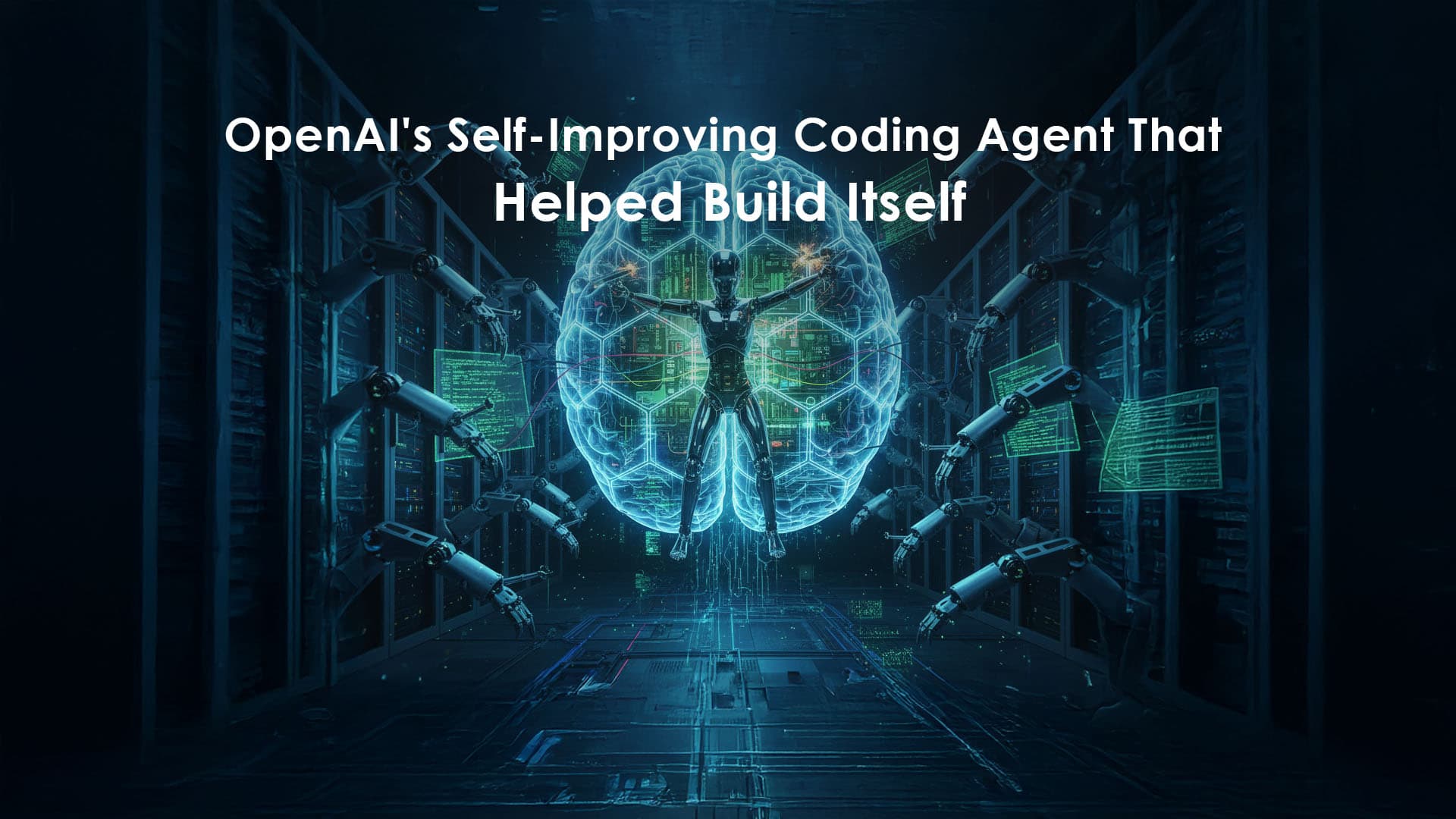
OpenAI's GPT-5.3-Codex isn't just another "slightly better" coding model it's a fundamental shift in how AI handles software engineering. As the newest brain behind the Codex agent, it sets new highs on real-world coding and terminal benchmarks, runs 25% faster, and was actually used by the Codex team to help design, debug, and evaluate itself. For developers, that combination of speed, autonomy, and self-improvement signals that Codex is evolving from smart autocomplete into a true engineering partner.
What Is GPT-5.3-Codex?
GPT-5.3-Codex is a specialized variant of OpenAI's GPT-5.3 model, purpose-built for agentic software engineering. It sits at the top of the Codex product line, succeeding GPT-5.2-Codex and GPT-5-Codex as OpenAI's most capable coding-focused model.
Core capabilities:
Most capable agentic coding model to date for complex, real-world engineering tasks
Combines GPT-5.2-Codex's coding performance with stronger reasoning and professional knowledge from GPT-5.2
Runs approximately 25% faster for Codex users while using fewer tokens on easy tasks and spending extra effort only when work is genuinely complex
Operates as a full agent framework that reads/writes files, runs tests and commands, calls tools, and maintains context across long sessions
Unlike a simple API model, Codex 5.3 lives inside a complete agent system with different approval modes (Chat, Agent, Agent full access), file access controls, and tool-driven workflows inside IDEs or project directories. GPT-5.3-Codex is the new intelligence layer dropped into that proven infrastructure.
State-of-the-Art Benchmark Performance
GPT-5.3-Codex achieves leading scores across multiple coding and agent benchmarks:
SWE-Bench Pro
A more difficult, multi-language successor to SWE-bench Verified that tests real GitHub issues and pull requests. GPT-5.3-Codex reaches state-of-the-art performance here, surpassing prior models that excelled only on the Python-focused SWE-bench Verified.
Terminal-Bench 2.0
Focuses on terminal skills—navigation, file operations, CLI tooling, and realistic agent workflows. GPT-5.3-Codex scores approximately 77% on Terminal-Bench 2.0, significantly higher than Anthropic's Opus 4.6 at around 65% on comparable tests.
OSWorld & GDPval
OSWorld evaluates agents interacting with full desktop environments (apps, UIs, multi-step workflows). GDPval measures agent performance as a win-rate on realistic tasks. GPT-5.3-Codex scores strongly on both, confirming it excels not just at static code completions but at multi-step, tool-using agent work.
These results show a critical evolution: performance is no longer just about "can it write the code?" but "can it manage the terminal, the repo, and the back-and-forth of a real task with minimal hand-holding?"
Speed, Efficiency, and "Thinking Where It Matters"
A major theme in the upgrade is intelligent efficiency—GPT-5.3-Codex is faster and more frugal with reasoning on easy tasks while going deeper on complex ones.
Two complementary behaviors:
For simple, well-scoped prompts (e.g., "fix this small bug," "add logging"):
Uses dramatically fewer tokens than GPT-5.x baseline models
Internal analysis showed GPT-5-Codex used 93.7% fewer tokens than GPT-5 on the easiest 10% of user turns
GPT-5.3-Codex continues this aggressive token-saving trend
For the hardest tasks (top 10% of complexity):
Spends up to twice as long thinking as GPT-5
Runs extended iterations of editing, testing, and debugging before returning results
Takes the time needed to get complex work right the first time
The result is about 25% faster performance for Codex users compared to previous versions, thanks to both model and infrastructure improvements. For developers, Codex 5.3 feels snappier on small tasks but patient on big ones—critical when you're paying per token and waiting for long refactors to complete.
The Model That Built Itself
One of the most striking details is how OpenAI actually used Codex in its own development loop.
According to OpenAI, early versions of GPT-5.x Codex and then GPT-5.3-Codex were used to:
Debug training pipelines and manage deployment configurations
Analyze test and evaluation results
Propose improvements to its own architecture and training setup
Run large-scale analyses of Codex session logs using regex classifiers and lightweight heuristics
Figure out how often users were satisfied, needed clarification, and how much progress was made per turn
OpenAI developers describe Codex 5.3 as having "fundamentally changed" their roles over recent months, as more drudge work—digging through logs, checking edge cases, proposing fixes—was handed off to Codex itself. An OpenAI product lead even suggested that "the vast majority of Codex is generated by Codex itself," emphasizing the degree of self-improvement in the process.
This reflects a reality many teams will face: as agentic models improve, they'll naturally be pointed at the most complex, messy workflows—including building and maintaining the next generation of models.
Better Collaboration: Progress Tracking and Steer Mode
A quietly important part of Codex 5.3's release is improved human-AI collaboration during long tasks.
New collaboration features:
More frequent progress updates during lengthy operations
Better responsiveness when you "steer" the agent mid-run (e.g., "focus on tests first," "split this into multiple PRs")
Smoother resume behavior if a task is interrupted
Steer mode is now stable and enabled by default:
Pressing Enter while the agent is working sends immediate steer instructions
Pressing Tab queues follow-up input, letting you control when feedback is applied
This makes Codex feel more like a human pair programmer you can talk to mid-task, not a black box that disappears until the job is done.
Additional tooling improvements:
New "allow and remember" options on tool approvals, reducing friction when agents repeatedly call the same tool
Better detection of live skill updates so configuration changes are picked up without restarts
Support for mixed text and image content in dynamic tool outputs for app/server integrations
How Codex 5.3 Fits the Broader Ecosystem
Even before 5.3, Codex had evolved into a comprehensive agent platform:
IDE and CLI Integrations
Runs inside editors like VS Code and tools like Cursor, reading files, making edits, and running tests automatically
Codex CLI enables agent capabilities directly from the terminal—where strong Terminal-Bench scores translate into fewer headaches
Early user reports suggest 5.3 rolled out to apps like Cursor shortly after launch
Azure and Enterprise Integration
Azure AI Foundry exposes GPT-5 Codex models as part of its reasoning models catalog
Documentation emphasizes approval modes (Chat, Agent, Agent full access), tool use, and agent creation with instructions and toolsets
Codex 5.3 slots in as the new top-end model with minimal migration pain
Security and Guardrails
"Agent (full access)" mode should only be used in tightly controlled environments due to the model's ability to read/write files and run commands without step-by-step approval
OpenAI continues publishing security guidance emphasizing sandboxing and access control
Codex 5.3 vs Claude Opus 4.6: Complementary Strengths
Codex 5.3 launched essentially within minutes of Anthropic's Claude Opus 4.6 release, prompting direct comparisons:
Benchmark | GPT-5.3-Codex | Claude Opus 4.6 | Winner |
|---|---|---|---|
Terminal-Bench 2.0 | ~77% | ~65% | Codex 5.3 |
OSWorld (Desktop Agents) | ~64.7% | ~72.7% | Opus 4.6 |
SWE-Bench Pro | State-of-the-art | Strong performance | Codex 5.3 |
Context Window | 400K tokens | 1M tokens (beta) | Opus 4.6 |
Speed | 25% faster than previous | Similar to Opus 4.5 | Codex 5.3 |
Qualitative behavior:
Codex 5.3 feels extremely reliable and precise on tough coding tasks
Opus 4.6 brings more creativity and higher variance—sometimes brilliant, sometimes requiring closer supervision
The consensus: Codex 5.3 is the terminal and repo specialist, while Opus 4.6 is more of an all-purpose desktop and analysis agent. For teams building coding-first agents inside terminals, CI pipelines, or IDEs, Codex 5.3 is a compelling primary choice.
What It Changes in Real Developer Workflows
Long-Running, Semi-Autonomous Tasks Become Practical
OpenAI observed earlier GPT-5-Codex models working independently for 7+ hours on large tasks, iterating until tests passed. GPT-5.3-Codex extends this capability with faster, more reliable performance—ideal for big refactors, framework migrations, "fix all occurrences" tasks, and systematic test coverage improvements.
Fewer Interruptions, More Progress Per Turn
OpenAI's own evaluation showed developers building with Codex were happier because the agent understood intent better and made more progress per turn with fewer clarifying questions. For developers, that means fewer "Can you clarify X?" responses and more "I made these concrete changes; here's what's next."
Better Fit for Multi-Tool, Multi-Modal Workflows
With support for mixed text and image outputs in tools and stronger reasoning across code plus UI states, GPT-5.3-Codex suits modern stacks where agents read logs, code, and screenshots together—perfect for UI testing, game development, and design+code workflows.
Higher Ceiling for Full Repo Understanding
GPT-5.x Codex variants already handle repo-level reasoning, but 5.3's improved benchmarks on SWE-Bench Pro and Terminal-Bench show that tying together multiple files, tools, and commands is now a core strength. This is particularly valuable for large monorepos or legacy systems where human onboarding is expensive.
A New Baseline for "AI That Builds AI"
Perhaps most importantly, Codex 5.3 normalizes the idea that frontier AI systems help build their own successors. That means future models will likely arrive faster with more iterative self-analysis—and teams building tooling on top of Codex can apply the same pattern in their own domains.
Open Questions and Risks
API Availability and Vendor Lock-In
At launch, GPT-5.3-Codex appears available primarily through the Codex app, with API access either limited or still rolling out. This can complicate adoption for API-first or multi-vendor stacks.
Safety and Autonomy Controls
Codex agents with "Agent (full access)" mode can read, write, and execute commands freely—so production deployment requires strong sandboxing and governance. As Codex gets better at self-directed work, the blast radius of mistakes (misapplied refactors, bad migrations) increases.
Benchmark vs Reality Gap
Benchmarks like SWE-Bench Pro and Terminal-Bench 2.0 are strong signals, but they compress organizational messiness into standardized tasks. Teams should expect a tuning period to align Codex 5.3 with their coding standards, repo layouts, and deployment pipelines.
Key Takeaway
Codex 5.3 is not a cosmetic upgrade. By combining state-of-the-art benchmark performance, 25% speed improvements, and real-world agentic behavior that OpenAI itself relies on to build Codex, GPT-5.3-Codex sets a new standard for what "AI coding assistant" means.
Ideal use cases:
Long, complex coding and refactoring tasks
Terminal-centric agents operating inside real dev environments
Systems where progress per turn and minimal hand-holding matter more than raw creativity
In a landscape where Anthropic's Opus 4.6 and OpenAI's Codex 5.3 push toward the same frontier from different angles, the choice is less about "which is smarter?" and more about where you want that intelligence to live. If the answer is "inside the repo, in the terminal, shipping code," Codex 5.3 is now one of the strongest tools available.
Summary of Key Improvements
Feature | GPT-5.3-Codex | Impact |
|---|---|---|
Terminal-Bench 2.0 | ~77% (vs Opus 4.6: ~65%) | Industry-leading terminal and CLI coding performance |
SWE-Bench Pro | State-of-the-art | Best-in-class on real-world GitHub issue solving |
Speed | 25% faster than previous Codex | Faster completions with intelligent token usage |
Token Efficiency | 93.7% fewer tokens on simple tasks | Massive cost savings on routine operations |
Self-Improvement | Helped build itself | AI-assisted model development becomes standard |
Collaboration | Steer mode + progress tracking | Real-time steering and better human-AI interaction |
Autonomy | 7+ hour independent sessions | Long-running tasks with minimal supervision |