
You ask your AI assistant to "write a script to sort my emails." What you get back sorts emails, sure—but it also alphabetizes your grocery list, renames random files, and somehow generates a haiku about productivity that accidentally gets sent to your boss. Your screen fills with error messages. You question your life choices.
The AI wasn't broken. Your prompt was.
This is the reality of AI-assisted coding: The difference between magic and disaster often comes down to a single sentence. A vague instruction produces code that's technically correct but wildly off-target. A well-crafted prompt? It generates clean, documented, production-ready solutions while you grab coffee.
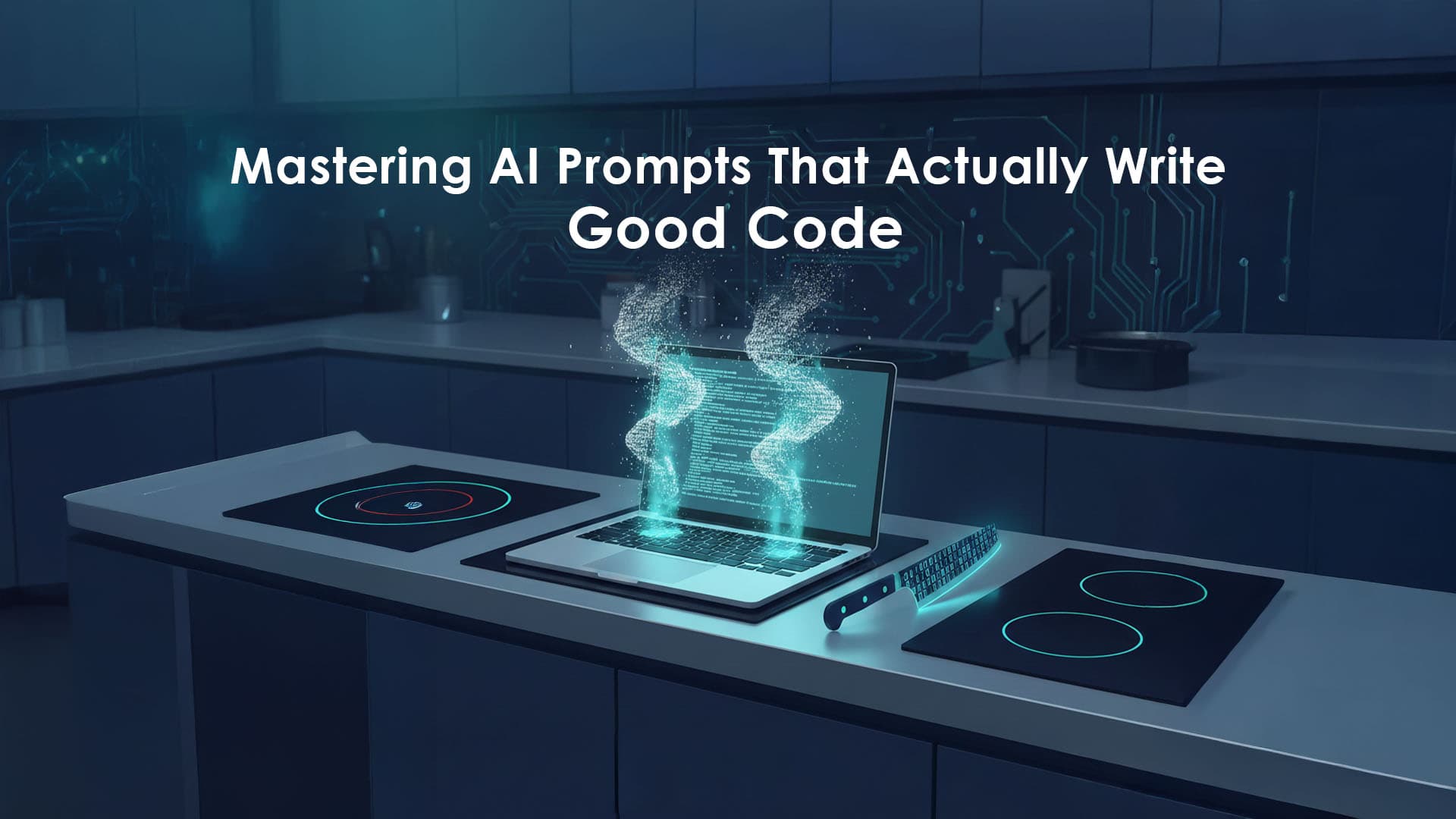
Welcome to Claude's Code Kitchen, a 10-part series that'll transform you from someone who fights with AI to someone who directs it with precision. We'll start with prompt fundamentals and build toward architecting full applications and automating complex workflows. Think of Claude as a brilliantly talented but extremely literal colleague—give clear instructions, and you'll accomplish incredible things together.
What Makes Claude Different
Claude is Anthropic's AI language model, built on what they call "constitutional AI"—a framework designed for safety, honesty, and reliability. Unlike models prone to hallucinating facts or suggesting questionable code, Claude prioritizes accuracy and explains its reasoning as it works.
For coding specifically, Claude excels across Python, JavaScript, TypeScript, Java, C++, C#, Ruby, Go, Rust, SQL, and over 30 programming languages total. It handles everything from quick scripts to complex framework-specific implementations in Django, React, or Express.js. More importantly, it's not just generating code—it's reasoning through problems, debugging issues, suggesting optimizations, and explaining decisions step-by-step.
The best part? Claude's free tier gives you access to Claude Sonnet 4.5, currently one of the most capable models available. Sign up at Anthropic's website with just an email—no credit card required. Free tier usage operates on dynamic limits that reset every few hours, which is plenty for learning and moderate projects. (We'll cover paid tiers and API access in later installments when we tackle larger-scale automation.)
For developers, Claude represents a shift from "coding assistant" to "reasoning partner." Anthropic's own engineers report using Claude for 60% of their work, with 27% of that being tasks they wouldn't have attempted manually—exploratory work, nice-to-have tools, scaling experiments.
The Three Pillars of Prompt Engineering
Prompt engineering is the skill that separates frustrating AI experiences from transformative ones. It's not magic—it's a learnable craft built on three core principles.
Structure: Build a Clear Blueprint
A structured prompt guides Claude logically through your request, eliminating ambiguity. Start with the goal, provide necessary context, then outline any specific steps or requirements. Use formatting like bullet points or numbered lists to make complex requests scannable.
Think of it like directing someone who follows instructions literally. "Make it work" versus "Create a Python function that accepts a list of integers, removes duplicates, sorts in ascending order, and returns the result" produces wildly different outcomes.
Specificity: Eliminate Assumptions
Vague inputs yield vague outputs. Be explicit about programming language, frameworks, performance constraints, edge cases, error handling, and output format. Want exception handling? Say so. Need it optimized for large datasets? Mention that upfront.
Without specificity, Claude makes reasonable assumptions that might not match your needs. You might get sorting by emoji usage instead of timestamp (true story from my early experiments). Specificity prevents those surprises.
Iteration: Refine Through Conversation
Your first prompt is a starting point, not the finish line. Review what Claude generates, then refine. Ask it to explain its approach, handle additional edge cases, or optimize for readability. This back-and-forth builds better solutions and teaches you what works.
Claude often suggests improvements in its responses: "If you'd like me to add validation, just let me know." Treat these as collaborative cues, not limitations.
Three Essential Prompting Techniques
Once you grasp the pillars, these three techniques will become your daily tools.
Role Assignment
Give Claude a persona that frames its response style. "You are an experienced Python developer specializing in data pipelines" produces different code than "You are a tutor explaining concepts to beginners." Role assignment taps into different response patterns in Claude's training, influencing everything from code complexity to comment verbosity.
Example Provision
Show Claude what you want rather than just describing it. Provide input-output pairs, similar code snippets, or reference implementations. This helps Claude pattern-match against your expectations instead of guessing.
For a data transformation task, including a sample input and desired output eliminates entire categories of misunderstanding.
Constraint Definition
Set explicit boundaries: "Use only standard libraries," "Keep it under 50 lines," "Make it readable for junior developers," "Prioritize performance over brevity." Constraints prevent overengineering and ensure the output fits your actual requirements and environment.
Practical Examples: From Basic to Refined
Let's see these principles in action with real prompts and outputs.
Example 1: Hello World Evolution
Basic Prompt (Minimal Context):
"Write hello world in Python."
Expected Output:
print("Hello, World!")Technically correct, but bare-bones. No explanation, no context, no utility beyond the absolute minimum.
Refined Prompt (Structured, Specific, With Role):
"You are a Python tutor teaching beginners. Write a 'Hello World' program with comments explaining each line. Include one interactive variation where the program asks for the user's name and provides a personalized greeting. Keep it under 10 lines total."
Expected Output:
# Basic output - the print() function displays text to the console
print("Hello, World!")

# Interactive variation - personalized greeting
name = input("What's your name? ")  # Get user input
print(f"Hello, {name}! Welcome to Python.")  # Display customized message
The difference? Context, educational value, and actionable variation. The refined prompt produced something useful for learning, not just technically accurate.
Example 2: Time-Based Greeting Function
Initial Prompt (Vague):
"Python script for time-based greeting."
This will work, but you'll likely get something minimal without error handling, structure, or explanation.
Refined Prompt (All Three Techniques Applied):
"You are a professional Python developer. Create a function that returns 'Good morning,' 'Good afternoon,' or 'Good evening' based on current time. Requirements:
Use the datetime module (standard library only)
Include error handling for unexpected issues
Format as a reusable function with docstring
Add inline comments explaining the logic
Keep it under 25 lines"
Expected Output:
import datetime

def time_based_greeting():
    """
    Returns appropriate greeting based on current hour.

    Returns:
        str: Time-appropriate greeting message
    """
    try:
        current_hour = datetime.datetime.now().hour

        # Morning: 5 AM to 11:59 AM
        if 5 <= current_hour < 12:
            return "Good morning!"
        # Afternoon: 12 PM to 5:59 PM
        elif 12 <= current_hour < 18:
            return "Good afternoon!"
        # Evening: 6 PM to 4:59 AM
        else:
            return "Good evening!"

    except Exception as e:
        return f"Error generating greeting: {e}"

# Usage example
print(time_based_greeting())
Notice how the refined prompt produced modular, documented, robust code with proper structure. That's the power of combining role assignment, specificity, and constraints.
Your Prompt Template: Copy and Customize
Here's a fill-in-the-blank template you can adapt for basic coding tasks:
You are a [role: e.g., senior JavaScript developer, Python automation expert].

Task: [specific goal: e.g., Create a function that validates email addresses]

Requirements:
- Language: [e.g., Python 3.10]
- Key features: [e.g., regex validation, return boolean]
- Constraints: [e.g., no external libraries, under 30 lines]
- Output format: [e.g., include docstring and usage example]

Explain your approach and include comments for clarity.
Test this right now in Claude's free tier. Customize the brackets, run it, and see what happens. Experiment with different roles, constraints, and requirements. The more you practice, the better you'll understand what produces clean results versus messy output.
What's Next
You now have the foundational toolkit: structure your prompts logically, be specific about requirements, iterate to refine, and use role assignment, examples, and constraints to guide output. These aren't theoretical concepts—they're practical techniques you'll use every single time you work with Claude.
In next artical, we'll put these principles to work on real automation tasks: file management scripts, ethical web scraping, data processing pipelines, and workflow optimization. We'll move from understanding prompts to building actual tools you can deploy.
Until then, practice with the template. Try generating a few simple functions—string manipulation, basic file operations, simple calculations. Pay attention to what makes prompts work versus what produces confusion.
What coding task frustrates you most? Debugging? Boilerplate generation? Learning new frameworks? Drop it in the comments—your challenge might inspire next examples.
Happy prompting.