
What Makes Claude Opus 4.6 Different
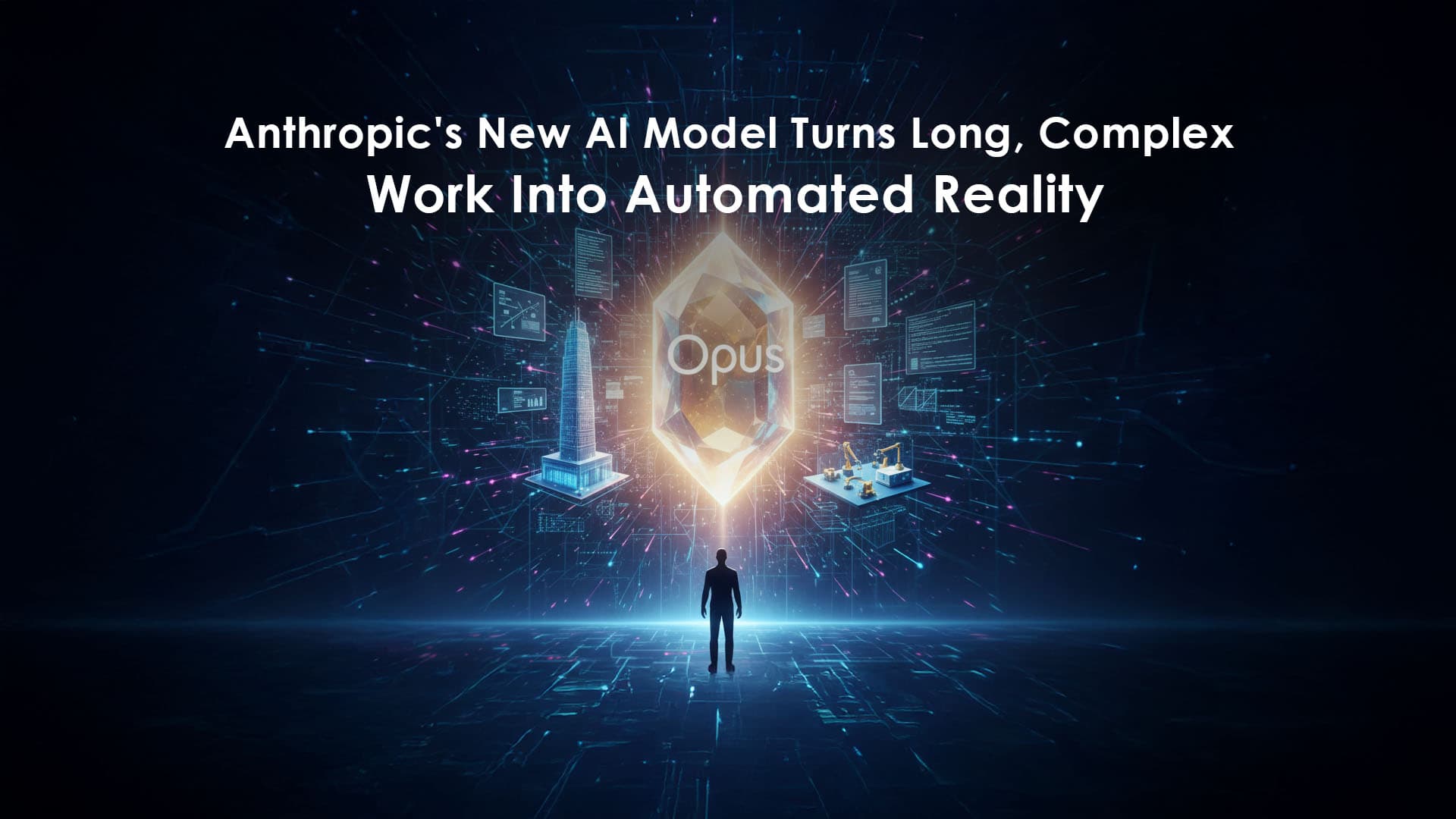
Most AI model launches recycle the same promises: higher benchmarks, more intelligence, flashier demos. Claude Opus 4.6 breaks from that pattern because it's explicitly designed for long-horizon work—the kind that usually crashes chatbots halfway through.
Released February 5, 2026, Opus 4.6 is Anthropic's most capable model yet, targeting complex coding tasks, agentic workflows, and enterprise-grade analysis that demand persistence, not just cleverness. It scored 65.4% on Terminal-Bench 2.0 (beating GPT-5.2's 64.7%), 72.7% on OSWorld for computer use tasks, and a striking 68.8% on ARC AGI 2—an 83% improvement over its predecessor.
Under the hood: a 1M-token context window (beta), deeper "adaptive thinking," and granular control over how much reasoning you pay for. If Claude 4 was Anthropic proving it could match GPT-4 and Gemini on quality, Opus 4.6 is about building AI that sticks with you through an entire project without forgetting, hallucinating, or giving up.
Core Upgrades: What's New in Opus 4.6
1M-Token Context Window (Beta)
Opus 4.6 ships with a 1 million token context window—enough to ingest roughly 750,000 words in a single session. More importantly, it can actually use that context without the performance collapse that plagued earlier long-context models.
On the MRCR v2 benchmark (multi-needle retrieval), Opus 4.6 scores 93% at 256K tokens and 76% at 1M tokens, far ahead of Sonnet 4.5's 10.8% at similar scales. Pair that with context compaction—where the model summarizes its own history to free up space—and you get effective sessions spanning multiple millions of tokens.
Real-world use cases:
Loading entire repositories plus design docs for refactors or security audits
Running multi-day research agents that don't lose the thread
Maintaining unified workspaces where requirements, experiments, and drafts live in one context
Adaptive Thinking + Four-Level /effort Control
Anthropic's "extended thinking" (chain-of-thought reasoning behind the scenes) now comes with adaptive thinking and a granular /effort parameter that lets you dial reasoning up or down.
Four effort levels:
Low: Skips thinking for simple tasks (classification, formatting)
Medium: Moderate reasoning for routine coding and transformations
High: Default for most production workloads; Claude thinks almost always at this level
Maximum: New to Opus 4.6; peak reasoning depth for the hardest problems (higher latency and cost)
In practice, this is budgeting intelligence. Run bulk tasks on low effort to save tokens, keep routine work at medium, and crank to maximum only for complex debugging or research questions that justify the spend.
On Anthropic's Humanity's Last Exam (a tool-using benchmark simulating real-world tasks), Opus 4.6 at high effort scores 62.7%, industry-leading under those conditions.
Agent-First Coding Behavior
Coding is where Opus 4.6 shines brightest. Anthropic calls it a "huge leap for agentic planning," especially for multi-step tasks requiring exploration rather than single-shot completions.
Key improvements:
Breaks complex coding tasks into parallel subtasks, runs tools and sub-agents simultaneously, and surfaces blockers precisely
Top score on Terminal-Bench 2.0: 65.4%, ahead of Opus 4.5 (59.8%), Gemini 3 Pro (56.2%), and GPT-5.2 (64.7%)
72.7% on OSWorld (agentic computer use), a significant jump from Opus 4.5's 66.3%
60.7% on Finance Agent benchmark, outperforming Opus 4.5 (55.9%) and Gemini 3 Pro (44.1%)
Early partners report outputs that "truly compare to expert human quality" in internal coding evaluations, indicating Opus 4.6 can handle large, unfamiliar codebases like a senior engineer.
Safety Without Compromise
Frontier AI models often trade capability for safety. Opus 4.6 maintains Anthropic's alignment standards while pushing performance:
Low rate of misaligned behaviors (deception, sycophancy, misuse cooperation)
Lowest over-refusal rate among recent Claude models, so it answers more legitimate questions without getting overly cautious
Matches or improves on Opus 4.5's safety profile
For enterprises running compliance and red-team audits, this balance matters: more capable and more usable.
Beyond the Terminal: Excel and PowerPoint Get AI Brains
Opus 4.6 isn't just for developers. Anthropic is quietly building a productivity moat by embedding Claude into the tools knowledge workers actually use:
Claude in Excel: Upgraded with stronger analysis, formula reasoning, and table manipulation
Claude in PowerPoint (research preview): Go from raw documents and data to structured decks faster
For finance teams, consultants, ops leaders, and strategists—people who live in Excel and PowerPoint—Opus 4.6 becomes invisible infrastructure, not a separate browser tab.
Availability, Pricing, and How to Use It
Where You Can Access Opus 4.6
claude.ai (Pro, Max, Team, Enterprise tiers)
Claude Developer Platform API as claude-opus-4-6
Amazon Bedrock and major cloud providers
Pricing (API)
Input: $5 per million tokens
Output: $25 per million tokens
Same as Opus 4.5, so upgrading is cost-neutral.
Who Should Use It
Dev teams building agents, dev tools, and research pipelines that need reliability over long sessions
Power users who outgrow mid-tier models on context length or coding complexity
Enterprises wanting a single "frontier brain" across web, API, and office integrations
If you're already using Claude 4 for heavy workloads, migrate your most complex tasks to Opus 4.6 and experiment with /effort controls.
The Bigger Picture: AI That Sticks Around
CNBC framed Opus 4.6 as part of a shift toward "vibe working" AI—systems that maintain context, follow through over time, and feel less like tools and more like collaborators. The phrase is awkward, but the concept is real: we're moving from prompt-and-reply to project-and-collaborate.
Opus 4.6 is Anthropic's clearest statement of that vision. The giant context window, compaction, adaptive effort, and agentic coding behavior converge on one promise: give the model a hard, messy task, and it won't fall apart halfway through.
For developers building the next generation of AI-native tools, researchers running long experiments, and enterprises automating knowledge work, that persistence is the difference between a demo and a deployment.
Key Takeaway:
Claude Opus 4.6 isn't just smarter—it's built to work longer, deeper, and more reliably than any model Anthropic has shipped before. Whether you're refactoring a legacy codebase, analyzing 500-page reports, or running multi-agent research workflows, Opus 4.6 is designed to be the AI teammate that actually remembers what you asked it two hours ago.
Feature | Claude Opus 4.6 | Impact |
|---|---|---|
Context Window | 1M tokens (beta), expandable via compaction | Handle entire codebases or multi-day research sessions |
Adaptive Thinking | Four-level /effort control (low/medium/high/maximum) | Tune cost, speed, and reasoning depth per task |
Terminal-Bench 2.0 | 65.4% (vs. GPT-5.2: 64.7%) | Top coding performance in agentic environments |
OSWorld (Computer Use) | 72.7% | Industry-leading tool integration and autonomy |
ARC AGI 2 | 68.8% (83% improvement over Opus 4.5) | Stronger novel problem-solving reasoning |
Finance Agent | 60.7% | Superior performance on real-world knowledge work |
Pricing | $5 input / $25 output per M tokens | Same as Opus 4.5—no cost increase |
Want to test Opus 4.6? Start with claude.ai if you're a Pro/Max/Team/Enterprise user, or hit the API as claude-opus-4-6 if you're building production workflows.