
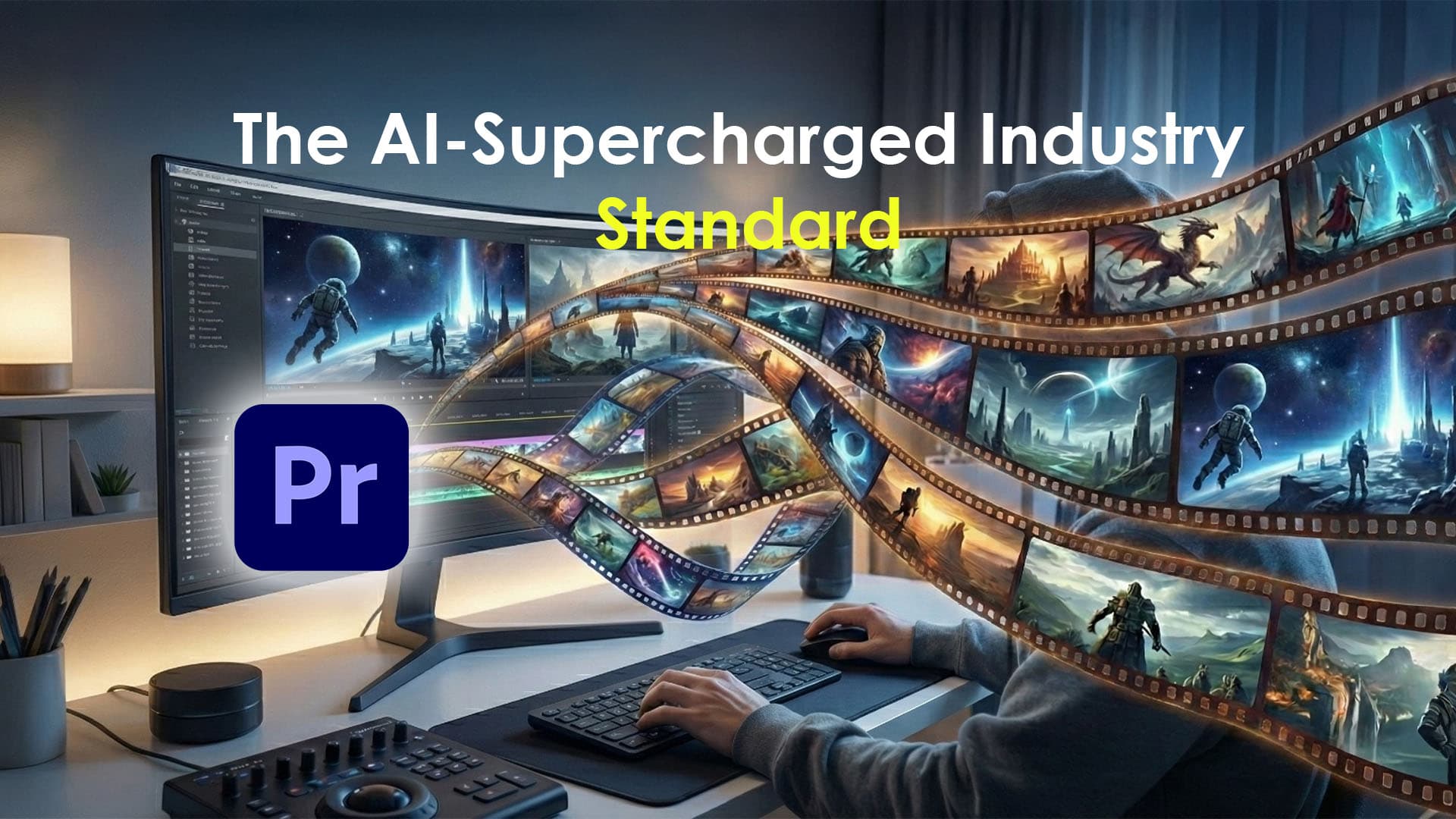
Adobe Premiere Pro Review: The AI-Supercharged Industry Standard
As the undisputed industry leader in professional editing for years, Adobe Premiere Pro has maintained its throne not by resting, but by evolving. It is the trusted choice for feature films, commercial production houses, and serious content creators.
Recently, Adobe has integrated a transformative suite of AI features. While these features are still maturing, they are designed to augment—not replace—the deep, professional-grade workflow that defines the platform. Adobe’s goal is to automate the most tedious parts of post-production to save professional editors significant time.
The Workflow: AI Meets the Timeline
Premiere Pro retains the familiar, powerful timeline editor that pros love, but it now includes a robust AI toolkit designed to enhance creativity and efficiency.
1. Generative AI Tools (Firefly)
Generative Extend: Powered by the Firefly Video Model, this tool intelligently lengthens video and audio clips to fill gaps and perfect timing. Uniquely, it supports 4K content generation.
Firefly Video Model (Beta): This feature allows you to generate entirely new B-roll clips from text prompts, perfect for fixing edits or adding shots on the fly.
2. Smart Editing & Audio
Text-Based Editing: Automatically transcribes footage, allowing you to edit video by simply deleting text. This is invaluable for documentary and interview content.
Enhance Speech (Sensei): A miracle worker for audio. It removes background noise and improves dialogue quality to professional standards.
Audio Remix Tool: Automatically retimes music tracks to match your video length, saving hours of manual cutting.
3. Workflow Automation
Media Intelligence: You can now search vast footage libraries using natural language queries (e.g., "man running on beach") to quickly find specific actions or objects.
Auto-Reframe: Automatically tracks action to reformat horizontal videos into vertical formats for social media.
AI Object Mask (Beta): Automatically outlines people or objects, making color grading and visual effects significantly easier without manual masking.
Auto Caption & Translation: AI-powered transcription and translation into 27 languages.
Pros & Cons: The Honest Truth
✅ The Strengths
Industry Standard: It offers universal compatibility and is trusted by professionals globally.
Powerful AI Tools: Features like Generative Extend and Media Intelligence solve real-world editing challenges rather than just being gimmicks.
Unmatched Ecosystem: Seamless integration with After Effects, Photoshop, and Frame.io makes collaboration effortless.
Performance: Optimized for fast rendering on modern hardware.
Community: A massive support network with limitless plugins, presets, and tutorials.
❌ The Weaknesses
Expensive Subscription: Costs range from $23 to $60/month ($276–$720/year).
Generative Credit Costs: Users must pay for usage-based Firefly generative credits on top of the subscription for features like Generative Extend, which increases expenses.
Steep Learning Curve: The massive feature set can be intimidating to newcomers.
Hardware Demands: It is resource-intensive and may lag on low-end or older machines.
No Free Audio Library: Unlike some competitors, users must source their own music and sound effects.
Pricing, Legal & Privacy
Cost: Plans range from $23/mo (Individual app) to $60/mo (Creative Cloud All Apps).
Commercially Safe: Adobe promotes Firefly as being trained only on licensed stock content and public domain media—never copyrighted works.
IP Indemnification: Enterprise customers receive legal protection for Firefly-generated content.
Data Privacy: Your user content is never used to train Adobe’s AI models.
Verdict
Adobe Premiere Pro remains the heavyweight champion. It is ideal for commercial production houses, marketing agencies, and serious YouTubers where the ROI justifies the cost.
If you need deep integration with the Creative Cloud and a tool that is commercially safe for high-end client work, Premiere Pro is non-negotiable. However, for hobbyists or those on a budget, the subscription fees and hardware demands may be a barrier.